|
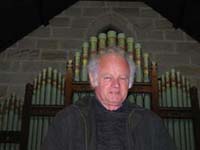
Music has played a leading part in John
Lloyd's life for a long time. He has studied and taught
it at the highest level. In the past, he played the french
horn and flute in bands and orchestras. He was the Director
of the Centre for Research and Education in the Arts at
the University of Technology Sydney. The list of choirs
and bands he has conducted includes the Conservatorium of
Music Choir and the NSW Transport Military Band. And just
recently, he's finished writing an opera.
His first encounters with the power of
music were at the village church in Nannerch, in the Alun
Valley. He clearly remembers hearing the male voice choirs
in full strength. "When you're a little kid and you
go along and see all these big men singing very, very seriously
and making a terrific sound . . . it's almost frightening,"
he said.
But he wasn't beyond mischief when he
used to pump the organ for the chapel service. Like all
the children, when it came to his turn, he enjoyed pumping
a bit too hard to make the organist's job just that little
bit more difficult.
"At the very end you used to let
the organ run out of wind just on the last Amen and it would
make a terrible sound as the sound came crashing down. Of
course, you would belt it before the organist caught you."
Nowadays he prefers making glorious sounds
and this is what he is endeavouring to do with his latest
project, conducting the Cantorion Sydney. The Cantorion
is a recently established all male voice choir which is
currently twenty strong. Eventually Lloyd hopes that number
will be fifty. They have a broad repertoire, singing folk
music from a range of countries, classical music and sacred
music from a variety of ethnic sources "including Welsh
of course."
I spoke to John Lloyd a month out from
the choir's first performance at a Welsh wedding in North
Sydney. The night before, they'd had a practice and he was
pleased with the group's progress and all the members were
looking forward to performing. "It's going very well
actually," he said. "They were really sounding
good in the church that we'll be singing in."
John lives on Scotland Island with his
wife Allison and his two border collies, Bryn and Bronwyn.
He shares the island with a number of other musicians, writers
and artists. There is a strong sense of community in which
he is involved. He plays in a quartet with other musicians
on the island and gives music lessons. Some of his students
recently performed in the island's annual festival, busking
and clowning around. John usually has an active interest
in the festival himself, but this year, it happened to fall
on the same day as the Cantorion's performance.
John Lloyd came out to Australia at the
age of 12. His father, a mechanical and electrical engineer,
was always concerned with the best interests of his children.
Although the language of the family was Welsh, his father
made all the children learn English in order to increase
their chances of getting a good job. After the second world
war, when the outlook in Wales was bleak, he took the opportunity
to help start up a factory for his firm in Newcastle.
After the factory went up, he had the
choice to return to Wales or stay on in Australia, and as
John explains, "He opted to stay, and of course we
all had to stay with him." He lived up in the Hunter
Valley until he completed his schooling and came down to
Sydney to study at the Conservatorium of Music.
It's obvious that he is happy in what
he does but John also feels a deep connection with his roots
back in Wales. "I can't go back and live there. I would
if I could but I've got family here. I've got kids here,
grandkids here, my wife's got grandkids here and you can't
just up and leave them," he said.
He keeps abreast of the situation in
Wales, returning every year or two and what he sees there
doesn't please him. Whilst he acknowledges the gains being
made in promoting the language and culture, he feels that
it isn't enough. "They're building huge castles on
an island that's going to be submerged because silently
all around Wales, the place is being bought up and changed.
It's becoming an English colony. An English province."
He feels Wales is being flooded by England.
On his last trip there, all the pubs he came across were
owned by English people, his old school's playground had
been taken to build homes for influx of people, and when,
in his home town, he asked for something in Welsh, the shopkeeper
asked if he knew how to speak English.
"I'm really well and truly - don't
get me wrong - without any apology, a Welsh nationalist," he
said. “The prospects for Wales to go it alone - to
succeed as an independent nation - are far better than
remaining as she is - dragged down - misused - bought
out - shackled to England. (Remember Wales is as large
as a number of the European countries) Her prospects are
better by far than most countries that have successfully
been granted their independence over the last fifty years.
(Because they are of no further value to their previous
colonial masters) The big problem of course is England.
England is not going to help Wales to independence. Wales
is too valuable a possession.” “Don’t
get me wrong!”, he said, I don’t hate the English
- but I hate what they have done, and what they are doing
to Wales and what is Welsh”.
Here in Australia, he thinks that like
all ethnic groups, the Welsh community has an important
cultural contribution to make, which it does through the
various societies, choirs and festivals. But back in Wales,
he feels there is a more pressing need - independence from
England - which is being waylaid by apathy, fear and greed.
Here in Australia, he thinks that
like all ethnic groups, the Welsh community has an important
cultural contribution to make to promote its presence and
also to assist newcomers. There are festivals, the Celtic
Council, societies such as the Welsh Society of Sydney and
the Gronfa and of course the choirs. And John Lloyd sure
has a big part to play in that.
|