 |
|
1 |
 |
|
 |
|
 |
|
|
1 |
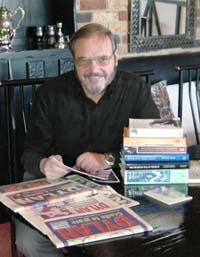
Earlier that day he had been on 'The Outing'- an annual event of the Dylan Thomas Society inspired by the poet's story of the same name. 'This year, the theme was Christmas in July.' It was a wonderful experience for Woosnam who was able to read out 'A Child's Christmas in Wales' with snowfall on the ground outside. As we arranged a time and place to meet, he expertly took control, listing possibilities and making suggestions in a methodical manner. When he later confirmed the details, he gave me detailed directions, ensuring all was clear. He is a well organised person and he needs to be as Woosnam is also the President of the Sydney Welsh Choir and is heavily involved in Newington College where he has taught for thirty-five years and now works in the Archives and with the Alumni Program. It was his ability to coordinate and plan that led to his initial involvement in the executive of the Sydney Welsh Choir. In preparation for its first international tour in 1990 an organising committee was formed to raise funds. Woosnam joined it in 1989. The next year, he was a member of the main committee and by 1991 he had become the president of the choir, just three years after joining. Having been president of the Dylan Thomas Society last year, he decided to take a break from it this year. As he says this, though, he is quick to add that he "may well be" returning to the position in the future. In fact, he expresses that he would happy to do so after finishing full time work at the end of the year. It's hard to imagine him idling his time away. After completing his studies and teaching for three years at Sloane Grammar School, Chelsea, Clive Woosnam first arrived in Australia in 1964 to work for the NSW Department of Education. He taught at the Correspondence School and was involved in preparing the Geography course for the new HSC brought in under the Wyndham Scheme. In Sydney he met his wife, Helen, when he was broadcasting at the ABC's 2FC radio station. He felt it was appropriate for someone in his profession to travel, in order to experience and discover for himself what it was that he taught in the classroom. In 1967, he and Helen left for Canada. After staying in Wales and England, they returned to Sydney in 1970 and he began teaching at Newington. After many years at the blackboard, he does not come across as stern or overbearing, but there is a clear purpose to the way he talks which demands respect. His speech is thoughtful and well delivered. As he retells an event or explains something, he is concise but thorough; direct but always polite. His rich bass voice, which loves to sing, rarely betrays his emotions but when he recalls a particularly meaningful thought or memory, his excitement shows. His pitch rises and his pace quickens. His enthusiasm becomes infectious. One such memory is the choir's visit to Canterbury Cathedral in the last international tour, two years ago. They had planned to do a short, a capella performance around the altar for the people passing by. The event wasn't going to be publicized, but. to their surprise they found a number of people who had gathered to hear them. Woosnam chuckles as he remembers what happened. "When we arrived we were amazed to discover that there were a lot of people who had come specially just to see us," he recalls. "They had found we were coming and we were welcomed by the chaplain to the Archbishop who was an Australian and who actually had been the vicar to a couple of people in our choir." "So he introduced us and at the end of the singing we had a little Welsh cleric, who was ninety-two years old and still lived in the Cathedral precinct, who thanked us in Welsh.It was great because we really weren't expecting it. We just thought we were going to be standing there singing while people walked past and it wasn't like that at all." As Clive Woosnam reflects on his love for singing, he feels it is important to acknowledge his father. He was gifted musically, and like his son, was a highly capable person. He conducted choirs and brass bands and played wind instruments and the organ as well as singing. Unfortunately, like many other miners he suffered a painful death from pneumiconiosis. Clive inherited his fathers passion for music and was captivated by the voice, both spoken and sung, from a young age. As a boy, he was a keen member of the Mid-Rhondda Children's Choir which won the 1950 National Eisteddfod, held in Caerphilly. "I really enjoyed my time in the choir but then [after that] I didn't really sing much," he said. When he went to grammar school, the emphasis was firmly placed on academic pursuits. He regrets the fact that there was little in the way of music or drama. While he worked towards his degree in Geography with Honours at the University College London he joined singing in the London University Choir, with whom he sang in St Paul's Cathedral, but then, once again, he stopped singing regularly. "When I came to Newington I got so involved in all the things there are here that I really didn't have ." He paused to correct himself, "I thought I had no time to do anything." He pauses again, thinking, and, this time with more expression and excitement, like someone sharing a secret, he says, "But it's surprising how it works because you can usually fit a lot more into your life than you know when you really try." Being part of the choir has been a rewarding experience. "I found myself at home in it very, very fast," he said. "In fact, after the first practice I went to, when I got home I couldn't go to sleep. I was just singing. My feet were kicking in bed." The only other time Woosnam shows such animation is when he talks about Dylan Thomas. As he tells how he became enchanted by the enigmatic poet from Swansea, he leans forward in his seat with his legs crossed and occasionally pauses to think and rub his forehead. "The thing that appealed to me when I was a boy was listening to Dylan read poetry, because he was quite often on the radio reading his own and other people's poetry. At the time, when most of the poetry readers were 'stiff upper lip Englishmen,' even though Dylan spoke with an English accent, he had the Welsh pulpit style. I'm not terribly fond of it nowadays but as a boy I liked it and he appealed to me me as a reader to begin with." Thomas' humorous short stories have always been special to Woosnam but the intricacy of some of his poems perplex him. "I find some of his poems willfully obscure. I find some of his poems just perculiarly morbid without any saving grace," he said. "There are many poems I try to grapple with." He holds a great deal of admiration for Thomas, fascinated by his attention to detail. He explains the poem, Prologue, with appreciation and care. The 104 line poem, he tells me, has a most peculiar rhyme pattern. The first line rhymes with the last, the second with the second last and the pattern continues so that the middle two lines rhyme with each other. "Of course, when you read the poem you've got no idea that anything rhymes," he said. "There is no concept of rhyme at all. It was only after he told someone later on that people realised it was actually happening." "He did obscure things which were for his own amusement, for his own sense of achievement, which no-one out there knew about. He was incredibly painstaking and time consuming with his poetry," he said. Thomas' amazing attention to detail and the planning and purpose which he put into his work strike a chord with Clive Woosnam. As Woosnam continues to tell stories of Dylan Thomas, the hour advances. Almost abruptly, he stops and says, "Anyway, I'd better get off and get some work done, I think."
|
|


|
Home
| Feature
Articles | W.S.S
|
Event Diary
| Choirs
| Members | Forum
| Links
|
|
Design:
www.thejr.co.uk
|